Image Contest Exhibition
We are pleased to present the contributions to this year's Image Contest!
Dendritic cells surrounding the arteriole in the spleen
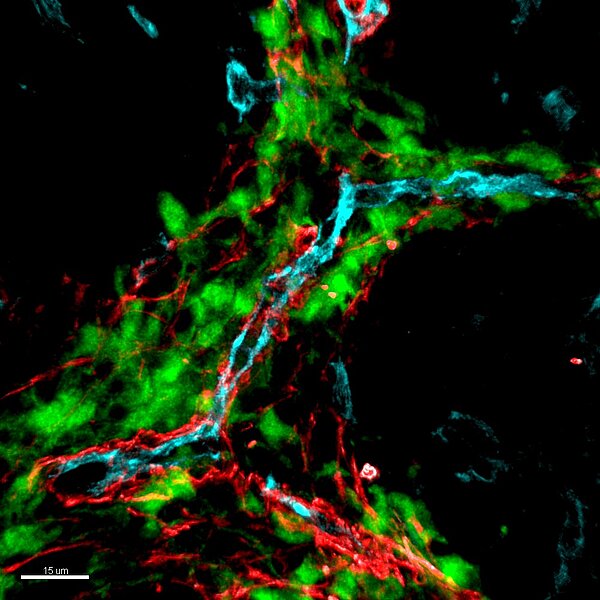
Green- XCR1+ cDC1, Cyan- CD31, Red- aSMA.
Splenic cDC1 migrate from the red pulp to the white pulp by following perivascular tracks surrounding arterioles.
- Anagha Rajeevalochana
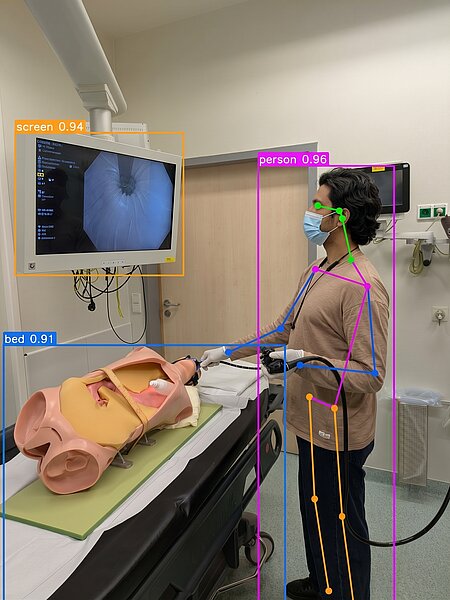
Endoscopy – View Through a Looking Glass
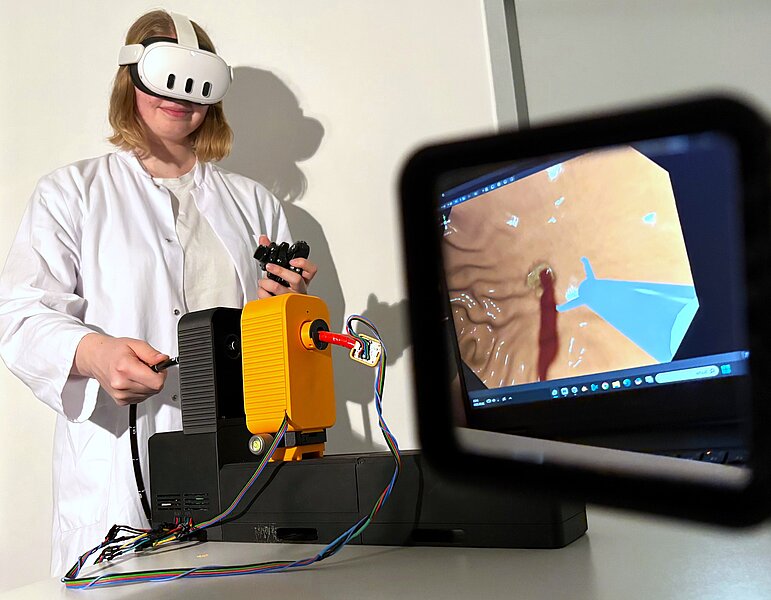
We developed OPTESK, a virtual reality (VR) training simulator for the endoscopic treatment of upper gastrointestinal bleeding. The endoscope's movements are tracked by sensors and transmitted to the VR simulation. The mirror reflects the endoscopy screen as seen by the user through the VR glasses.
-Annika Koehler
Inside Out!!!
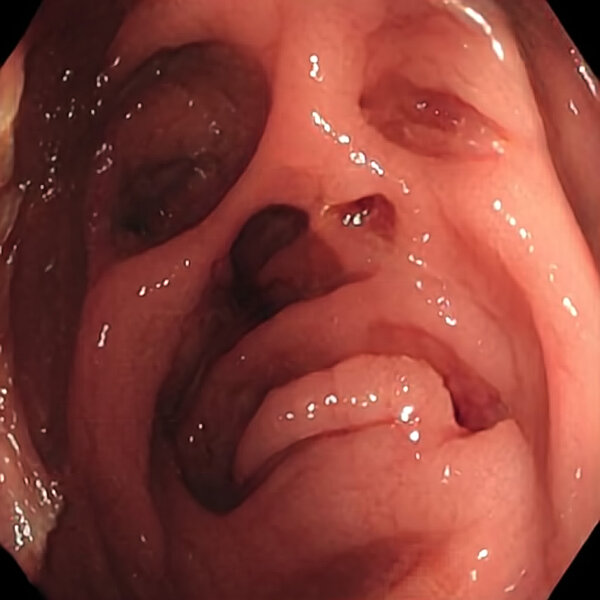
This is my face, rendered as colonic mucosa. SiMucosa, our real-time AI style transfer, was built to make silicone endoscopy phantoms look like living tissue so trainees can practise on something convincing. Pointed at a portrait instead, it does this. The model knows one style and applies it to everything.
-Harsha Manjunath
PostureMeister: AI-driven ergonomics for endoscopy
Guidelines for Ergonomic Endoscopy exist only on paper and nothing verifies them in the Endoscopy-room. PostureMeister uses depth cameras and pose estimation to track body keypoints, then computes an optimal monitor and bed height for each individual and compares it against ASGE guideline targets. The goal is healthier endoscopists and longer careers.
- Irshath Ali Syed
A Cellular Battle Against Glioblastoma
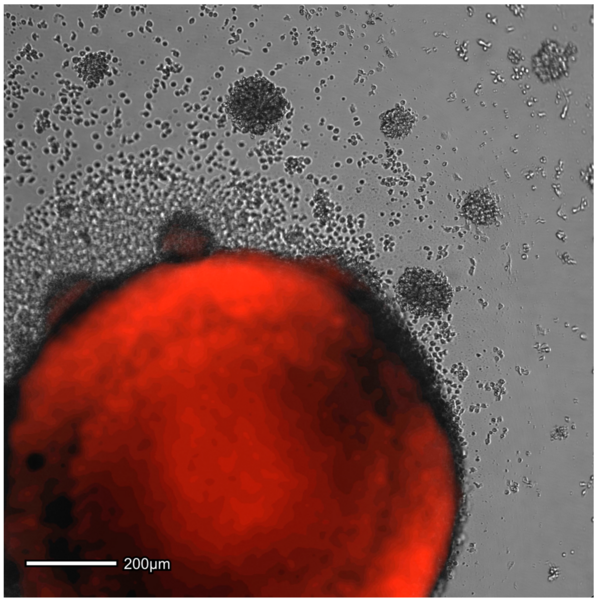
GD2-targeted CAR T cells a3acking a glioblastoma organoid.
-Maximilan von Bank
We CARe about tu(a)mor ❤

-Sabrina Ciccone
“Just don’t…”
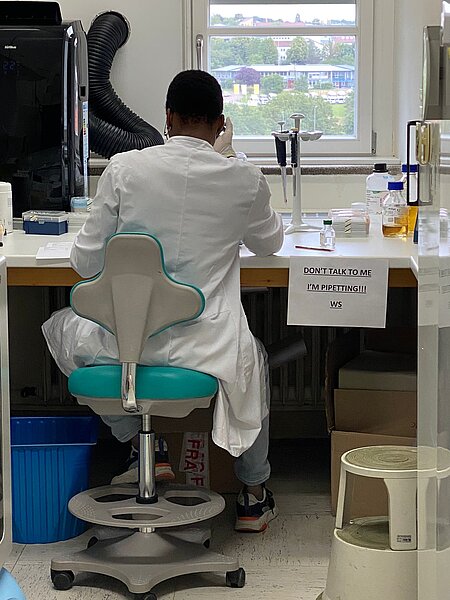
I think no description is needed
- William Lokossou Sanvi
Cyanotype of Phenotype
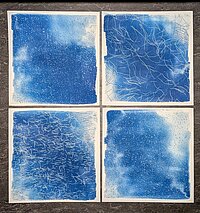
A cyanotype of E. coli phenotypes produced by CRISPRi knockdown of essential genes. Four microscopy images compare wild-type cells (WT) with knockdowns of ftsZ (top right), mrdA (bottom right), and rplA (bottom left).
Cyanotype printing uses a light-sensitive iron-based process: UV exposure reduces Fe(III) to Fe(II), which reacts with ferricyanide to form insoluble Prussian blue.
- Felix Knote
Biology does not always happen in a lab
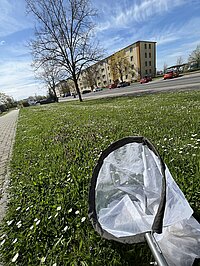
From outside it must´ve seemed a bit odd how I slowly trailed the campus, my net in hand, stopping at seemingly random intervals. But for me everything made perfect sense: I traced patches of Lamium purpureum, stopped when detecting a buzz, and swept when I saw a bumblebee queen. From outside it must´ve seemed a bit odd how I slowly trailed the campus, my net in hand, stopping at seemingly random intervals. But for me everything made perfect sense: I traced patches of Lamium purpureum, stopped when detecting a buzz, and swept when I saw a bumblebee queen.
- Johanna Ott